



Country
United States
Important directions in the development of modern truck designs
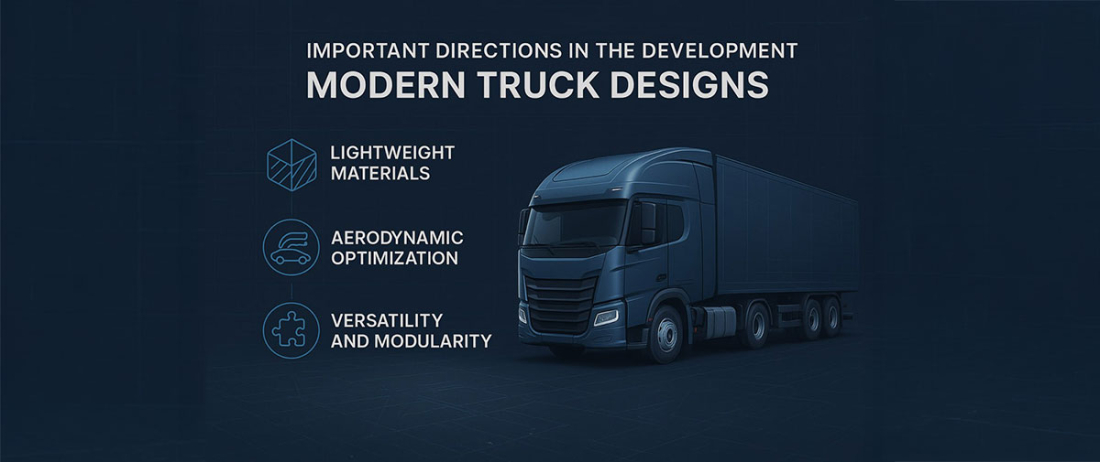
Technological priorities in truck design
Among the main requirements for modern trucks are weight reduction, increased service life, efficiency and environmental safety. Volvo truck parts are often chosen when fleets prioritize durability, efficiency and predictable service intervals. New materials and technologies make it possible to solve these problems without losing strength and reliability. Important parameters for improving trucks are:- use of lightweight materials;
- aerodynamic optimization;
- versatility and modularity.
Electronic control units and sensors provide control over the main systems. These include brakes, transmission, suspension. In braking and control systems, many fleets rely on proven solutions and service availability of wabco parts. Sensor electronics and control modules are also commonly associated with bosch parts in heavy-duty applications. With the improvement of the listed elements, the driver assistance functions are expanded - stabilization, lane keeping, collision prevention. Also, the modern design allows the owners of equipment to bring more profit from the transportation of goods.
Versatility and modularity of trucks
Designing trucks on a modular principle gives manufacturers and operators significant advantages. Unification of components and platform flexibility reduce production and maintenance costs. The advantage of the modular approach is adaptation to different tasks. A tractor, dump truck or special equipment can be assembled on a single chassis with minimal design changes.Unified units are easier to diagnose and replace and repairs do not require rare parts. Standardized platforms also simplify sourcing and stocking core items like man parts across different vehicle configurations. The same logic applies to scania parts, where component unification reduces downtime and logistics costs. This simplifies maintenance and logistics costs. Common platforms simplify the storage of spare parts and supply logistics. For aftermarket equivalents and cross-references, the diesel technic catalog is often used in service practice. Therefore, modern freight transport is much more efficient than outdated models.
Priority of energy efficiency and environmental friendliness
Fuel saving and emission reduction are becoming a priority in new vehicle models. Manufacturers are implementing advanced solutions:- robotic gearboxes with intelligent control (see zf catalogue for compatible drivetrain components);
- exhaust gas recirculation systems;
- energy recovery technologies during braking;
- automatic start-stop systems.